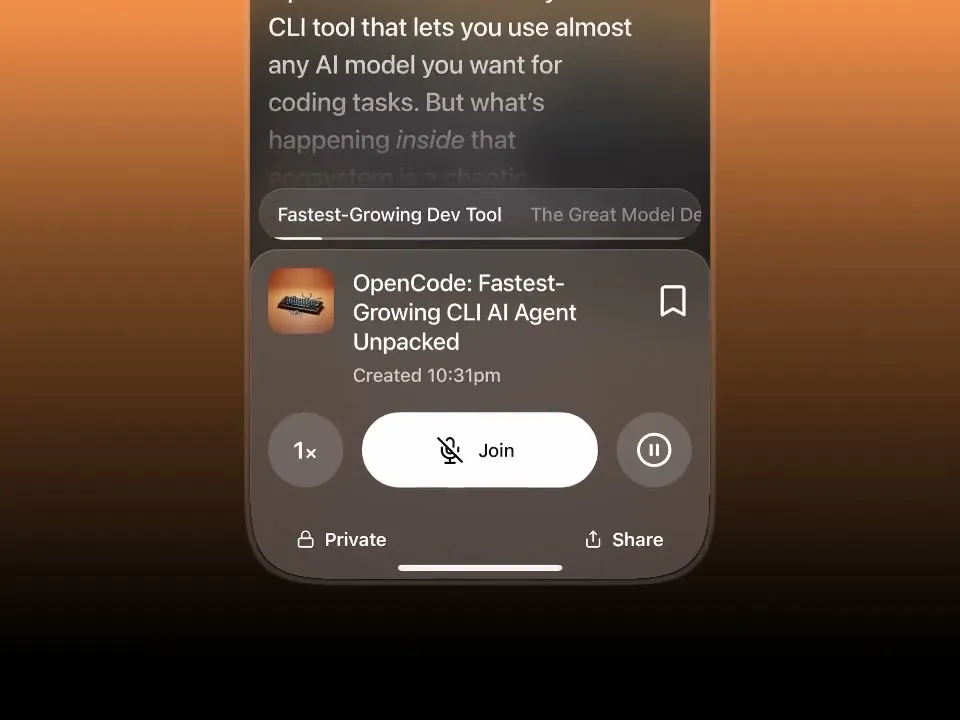
Huxe: Building an Interactive Listening Experience
Introduction
When I first joined Huxe, it wasn’t an AI podcast app at all.
We were building an AI-powered business assistant with Next.js, integrating tools like Slack, Salesforce, and Shopify to help users analyze business data and identify potential issues.
After several pivots, Huxe became a voice-first mobile app that turned emails, calendars, and personalized news into daily audio briefings and interactive podcasts. This was my first time working on an AI product professionally, and I got to experience that evolution firsthand.
What I Worked On
I initially worked on the Next.js web app before moving to React Native as we shifted to mobile. My work ranged from interactive audio experiences and animations to native integrations and performance optimization.
One of the best parts was working with a designer and engineers who cared about the little details, while exploring technologies I hadn’t worked with before. Here are some of the parts I particularly enjoyed.
Curated Works
Daily Brief Experience
One of the parts I enjoyed working on the most was the daily brief experience.
The daily brief lets users follow along with the audio and jump to specific topics. One challenge was coordinating nested scrolling: the briefing is a scrollable list of cards, each with its own scrollable content.
As the audio progresses, the app scrolls to and expands the relevant card while collapsing the previous one. Selecting a card seeks to that topic in the audio, so scrolling, card states, and playback all needed to stay synchronized without sudden jumps.
Following along with the audio
The listening experience also included a transcript that moved along with the audio, so users could follow what was being said while listening.
Micro-interactions
I personally don’t like it when elements suddenly appear, disappear, or jump between states without a transition. At Huxe, I worked with React Native Reanimated to make these changes feel more natural and easier to follow.
When switching between Research and Use Sources, I added fade-in and fade-out transitions so each section appeared and disappeared smoothly.
The Daily Brief’s card transitions and the transition back to the home screen are examples of how motion helps connect different parts of the interface.
For example, even something as simple as the transition between a play and pause button can feel better when the change isn’t abrupt.
I also had to make sure these animations stayed smooth when multiple things were happening on screen.
Working with Native Modules
To let users keep listening outside the app, I worked with native media players and integrated playback controls with the iOS and Android media interfaces, keeping play and pause states synchronized.
We also supported listening through Apple CarPlay and Android Auto.
I also got to work directly with native modules and patch some dependencies to support the behavior we needed.
Coming from a React Native background, this was a good opportunity to learn more about how the framework interacts with the underlying native platforms and the differences between iOS and Android.
Performance Optimization
The daily brief combined nested scrolling, dynamic content, and frequent audio playback updates. I investigated performance bottlenecks, reduced unnecessary re-renders, and paid attention to component lifecycles, especially the cost of repeatedly unmounting and remounting heavy components.
The goal was to keep the interface responsive without doing unnecessary work, while accounting for lower-end devices as well as our development phones.
Lessons Learned
Huxe taught me to pay attention to how an app feels on a physical device, beyond whether it works in a simulator. Small delays, abrupt transitions, and dropped frames can be noticeable. I started asking whether an animation felt natural, whether an interaction responded quickly enough, and whether haptic feedback would help.
Working with Reanimated and investigating performance also reinforced the importance of understanding the tools I use. AI has made building and learning faster, but knowing a framework’s strengths and limitations still helps me make better decisions about what I build.
I’m grateful for the people I worked with at Huxe and the chance to explore so many things I hadn’t worked with before.